Nutanix helps accelerate EHR and PACS deployments, providing a standardized, repeatable, cost-effective solution with predictable performance and scalability. The case studies throughout this book provide direct evidence that Nutanix simplifies infrastructure, improves performance, facilitates scaling, and reduces costs.
With Nutanix, you can virtualize your EHR or PACS environment (or both) using your choice of hypervisor while using up to 80% less space than traditional architectures require. Simplified scaling enables you to go from pilot to production and beyond without re-architecting or incurring downtime. When a component such as a disk fails, Nutanix systems automatically self-heal, quickly restoring full resiliency and thereby reducing risk.
This section examines how Nutanix solutions address the needs of the diverse components of EHR and PACS. In particular, we look at application and desktop virtualization, a frequent source of problems.
Healthcare organizations choose desktop and application virtualization solutions to keep sensitive patient information secure. With these solutions, information remains in the datacenter and is not stored or cached on end-point systems. These solutions also provide better support for mobile workers and BYOD initiatives, increase user productivity, and reduce costs compared to desktop PC deployments.
Roughly three quarters of healthcare institutions use application virtualization to provide each active worker with remote access to individual application instances. The remaining institutions use a combination of desktop and application virtualization. Many of the challenges associated with EHR and PACS involve the deployment of these solutions.
Application and desktop virtualization is far more challenging than server virtualization. A healthcare organization may have hundreds to thousands of users, each with unique expectations, application requirements, and perceptions.
Virtual desktops generate write-heavy workloads with random storage I/O. This makes maintaining consistent performance difficult: demands can swing wildly depending upon usage patterns, time of day, and the applications being used. Boot storms, anti- virus scans, and patch updates can all put sudden loads on the infrastructure and slow down performance for end users.
Healthcare institutions frequently roll out an application or desktop virtualization environment over an extended period to replace existing desktop hardware as it reaches end of life. With legacy infrastructure, scaling is a challenge, particularly when it comes to storage performance. You either purchase storage arrays up-front with far more performance and capacity than you need, or risk forklift upgrades later.
A recent analyst study of 19 organizations that deployed either VMware- or Citrix-based solutions showed that 17 of the organiza- tions spent more on storage than expected. Storage, on average, accounted for 40%–60% of the entire VDI budget.
Nutanix takes the risk out of application and desktop virtualization with VDI Assurance, guaranteeing the performance of virtual desktops as healthcare deployments expand. If a Nutanix configuration covered by VDI Assurance is unable to deliver the expected performance, Nutanix will remedy the situation.
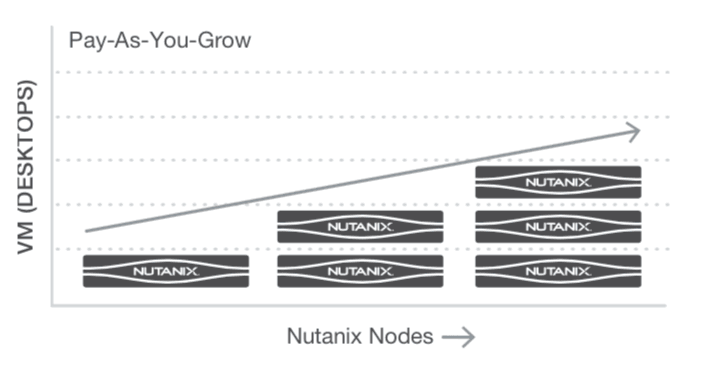
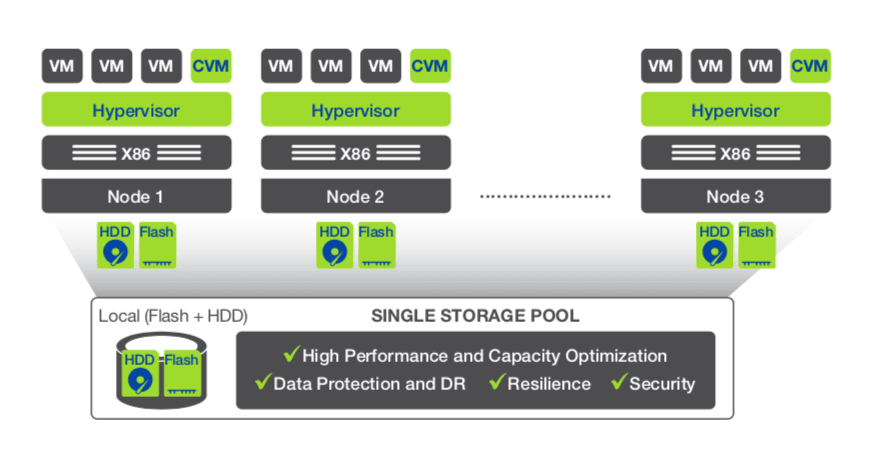
Nutanix addresses the performance and scaling challenges of application and desktop virtualization. Because each node added to a Nutanix cluster includes both compute and storage, scaling is linear. Each additional node supports a predictable number of additional users.
Nutanix Prism gives you a single intuitive console to manage all servers and storage. Having actionable data at your fingertips cuts the time spent managing infrastructure by as much as 70%.
Figure 4: Linear scale-out takes the surprises out of expanding your application or desktop virtualization installation
Nutanix supports leading application and desktop virtualization solutions including:
Hypervisors supported include:
With some healthcare software solutions, the core database is proprietary software that is only supported on a limited number of hardware platforms—such as legacy UNIX systems. Many organi- zations that are modernizing existing EHR and PACS systems retain the database on physical hardware, either for continuity or because virtualization of the database is not yet supported.
This will likely change over time. Virtualizing a database, when possible and supported by the EHR or PACS vendor, provides significant manageability and scaling benefits and eliminates siloed infrastructure.
Separate analytics systems may be necessary to unlock the full value of EHR and PACS data and to support initiatives such as value-based care and population health management.
Depending on your particular solution or solutions, performing analytics can require extracting data into a secondary database. For example, Cogito Clarity, the analytics and reporting suite for Epic EHR, extracts data from the production database into a Microsoft SQL Server or Oracle database.
With legacy infrastructure, new servers and storage are often required to support analytics. With Nutanix, it is simple to absorb analytics or other database workloads into an existing cluster— adding new nodes if necessary—without impacting the cluster’s ability to run existing workloads.
Nutanix infrastructure is proven for running data warehouses and associated applications. The database and analytics applications run in virtual machines deployed on one or more nodes in the cluster. With software-defined intelligent tiering, data used by each virtual machine is automatically tiered between (1) local flash, (2) remote flash, (3) local disk drives, and (4) remote disk drives. Frequently read data is deduplicated and cached in RAM and local flash, and data is always written to flash.
Figure 5: The Nutanix Distributed Storage Fabric uses intelligent tiering and data locality to optimize performance for database, analytics, and other workloads running on a cluster. Numbers indicate the tiering priority with respect to VMs on Node 1: local flash, remote flash, local HDD, remote HDD
Intelligent tiering delivers excellent sequential read/write perfor- mance to support analytics. It also delivers excellent random read/write performance for transactional databases.
Data protection and DR for EHR and PACS deployments are essential to ensure that critical patient data is always available. Nutanix improves data protection by simplifying and consolidating infrastructure, and providing efficient data services to address data protection and DR needs. In many instances, data protection and DR can be provisioned without requiring third-party solutions that add expense and complexity. However, Nutanix offers full integra- tion for leading solution providers if you already have a solution in place, or your EHR or PACS has specific requirements or limitations.
Nutanix meets your uptime, RPO, and RTO needs and maintains mission-critical levels of availability using a combination of features, including tunable redundancy, integrated data protection, the Nutanix Metro Availability solution, transparent Nutanix Controller VM failover, and non-disruptive upgrades. For more information on these solutions, download the Nutanix Tech Note on data protection and disaster recovery from www.nutanix.com.
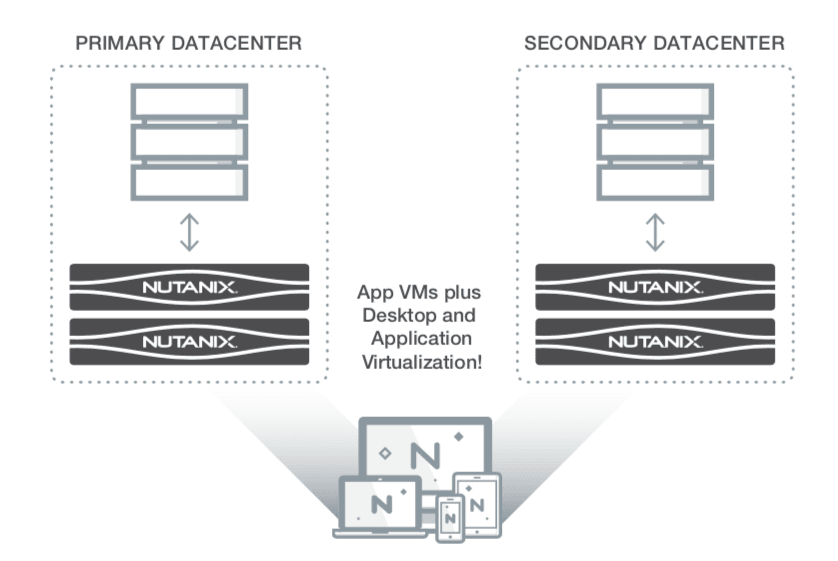
Figure 6: Nutanix provides full data protection and disaster recovery for important healthcare applications
Nutanix offers a range of integrated data protection options to ensure continued access to important healthcare applications and data in the face of component failure, node failure, rack failure, or an entire datacenter outage.
Rather than rely on RAID, the Distributed Storage Fabric maintains two or three copies of all data for resilience. If one copy becomes unavailable for any reason, an alternative copy is accessed. With self-healing, full resiliency is restored automatically in the background, and there is no long period of “degraded mode” operation that impacts application performance and increases risk.
You can back up applications locally, to a Nutanix system at a remote site, or to a cloud service provider. Nutanix Prism simplifies backup management by giving you centralized control of backup policies for multiple sites.
For DR, choose from asynchronous or synchronous replication. By compressing and deduplicating data before it is sent over the wire, these technologies reduce storage footprint and network bandwidth by as much as 70%.
For critical workloads requiring zero RPO and fast recovery, Nutanix offers Metro Availability, which uses synchronous replication to ensure continuous data availability across different sites during planned maintenance or disasters. Metro Availability greatly simplifies DR and eliminates the need for secondary solutions.
A unique aspect of a PACS environment is the size of individual image files and the total amount of data that has to be stored for an extended period. Nutanix environments accommodate the storage needs of different workload mixes by offering a variety of node types including compute-heavy, storage-heavy, and storage- only options. A Nutanix cluster supporting PACS requirements may add storage-heavy and/or storage-only nodes as needed to get the storage mix right without overprovisioning. Nutanix data reduction technologies—including deduplication and compres- sion—reduce the total amount of data storage required.
A unique aspect of the Nutanix scale-as-you-grow approach is that as you add new nodes over time, you are always adding the latest processor and storage technology. By adding new nodes and retiring old nodes when necessary, you create infrastructure that stays current and never requires disruptive upgrades.
EHR and PACS deployments typically require a variety of other services, such as application servers, print servers, management servers, and authentication. In a Nutanix cluster, these services are all virtualized.
Nutanix provides full support for VMware vSphere and Microsoft Hyper-V, as well as Nutanix AHV. Many different virtualized workloads can be supported on a Nutanix cluster using the hypervisor(s) of your choice.
Healthcare workers at Care New England needed to maintain access to VDI sessions while changing locations. And increasingly, they wanted to use personal devices, phones, tablets, laptops in and out of the hospital. VDI infrastructure has to support a large number of applications, including EHR and PACS, without performance impact. Other requirements included consistent and predictable performance, real-time metrics for monitoring and troubleshooting, and elimination of forklift upgrades.
The IT team looked at various SAN solutions but chose a Nutanix enterprise cloud as a simpler, more cost-effective approach.
Nutanix provides a number of big advantages for Care New England:
FAST LOGIN. Login times with the previous SAN environment were 2.5 minutes. That is down to a consistent 35 seconds; and it takes just 5 seconds to reconnect to an existing session.
CONSISTENT PERFORMANCE. The data locality provided by the Nutanix Distributed Storage Fabric delivers much more consistent performance. There are no unpredictable slowdowns during the day.
COMPREHENSIVE DASHBOARD. The Nutanix dashboard streamlines monitoring and management. Just two people manage a VDI environment that will soon scale to 3,000 seats, with more time to focus on value-added projects.
GREATER AGILITY. If IT has to add new software, the team can rebuild the gold desktop image in just 25–30 minutes; with the old system, it took three hours. Confident M&A. Changes used to cause huge login delays and slow- downs. Ease of deployment and rapid scaling give the team confidence onboarding new customers and apps.